

What Is a Paper Towel, Exactly?
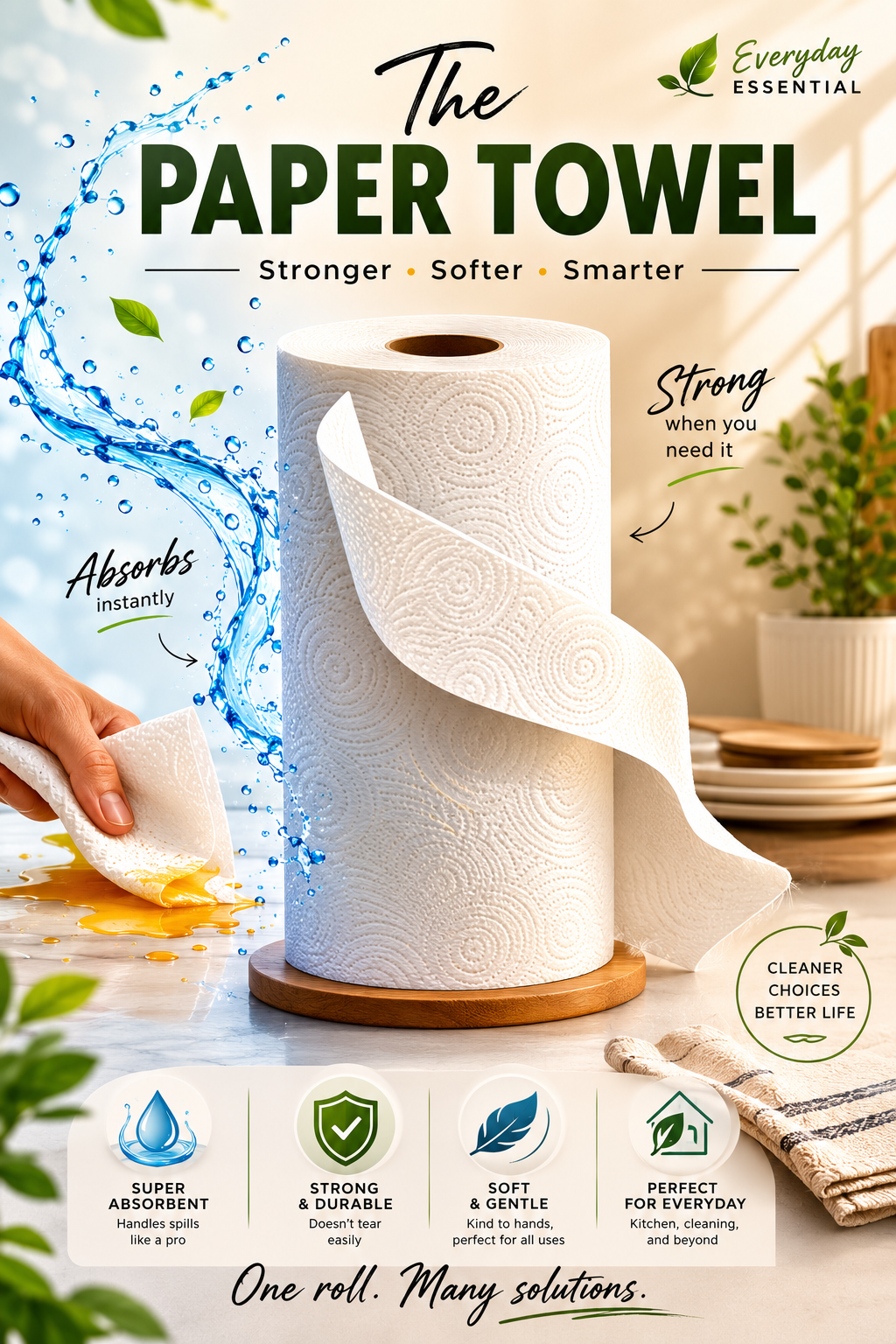
Ask someone what a paper towel is and you’ll get a shrug. It’s the thing on the roll by the sink. Fair enough — most days that’s all it needs to be. But the paper towel meaning goes a bit deeper than “absorbent paper,” and it’s worth knowing why, mostly because it explains why one roll at the store costs three times what the roll next to it costs.
Here’s the short version: a paper towel is a disposable sheet made from paper pulp, built specifically to soak up liquid and grab onto debris. It’s not just thick paper. Regular printer paper is pressed tight and smooth. Paper towels are the opposite — they’re manufactured with a loose, uneven weave on purpose.
That looseness does the actual work. It leaves tiny gaps between fibers, and those gaps pull water in through capillary action — the same basic physics that lets a plant pull water up through its roots against gravity. Run your thumb across a sheet sometime. You can feel that texture doing its job.
There’s also a manufacturing step called creping, where the sheet gets scraped off the drying cylinder in a way that bunches the fibers together slightly instead of leaving them flat. That’s why paper towels look a little wrinkled compared to notebook paper — the wrinkle is what gives them stretch and bulk, and honestly, most of their absorbency too.
So what is paper towel used for, beyond the obvious spill? Drying hands, wiping counters, blotting grease off bacon, cleaning windows, packing something fragile for a move, and — I’ll admit this one myself — starting a stubborn campfire when the kindling’s damp. Not many household items pull double duty across that many completely unrelated tasks.
A Short, Slightly Surprising History
Paper towels weren’t exactly invented on purpose. In 1907, the Scott Paper Company in Philadelphia got stuck with a shipment of paper rolled too thick to work as toilet tissue — basically a factory mistake. Company president Arthur Scott didn’t scrap the batch. He’d heard about a local schoolteacher handing out individual paper sheets so students could dry their hands without sharing a germy classroom rag, and the idea stuck with him.
He perforated the thick paper into small towel-sized sheets and started selling it to schools, restaurants, and railroad stations as “Sani-Towels” — a hand-drying product built for hygiene, not the kitchen.
The kitchen version came later, and it took a while. Scott began producing longer rolls aimed at home cooking and cleanup in 1931, and it wasn’t really until the postwar boom of the 1950s — when disposable income and disposable products both took off together — that paper mostly replaced the cloth rag as the default kitchen wipe-down tool in American homes.
Why bring up ancient company history in a buying guide? Because it explains a split that’s still very much alive on store shelves today: institutional paper towels built for restroom dispensers on one side, and the softer, printed rolls sold for home kitchens on the other. Same accidental invention, two very different products by the time they reached the shelf.
Kitchen Paper Towel vs. Bathroom Paper Towels
Most people treat “paper towel” like one category. It isn’t, really. Kitchen and bathroom paper towels get engineered around different priorities, and if you grab the wrong one for the job, you’ll notice — usually mid-spill.
Kitchen paper towel rolls are built for food-contact absorbency first. They need to handle grease and hot liquid without falling apart in your hand, hold together when soaked (this is what’s called “wet strength” in the industry), and absorb fast, because a spilled pot of pasta water doesn’t wait around.
Bathroom paper towels are a different animal. They’re almost always designed around hand-drying, not spill cleanup, which means they end up thinner and less textured — hands need blotting, not scrubbing. They’re also more likely to come as folded stacks instead of rolls, since most public restrooms use dispensers, and they’re priced lower per sheet because offices burn through volume fast.
If you’ve ever tried drying your hands with a heavy-duty kitchen roll, or mopping up a wine spill with thin restroom tissue, you already know exactly why this distinction exists.
Understanding the Paper Towel Roll: Sheet Count, Ply, and What Actually Matters
Buying a paper towel roll seems simple right up until you’re standing in an aisle comparing four brands, four sheet counts, and four different “value size” claims that somehow don’t line up. A few things are actually worth checking.
Ply refers to how many layers of tissue are bonded together per sheet. 1-ply sheets are thin and cheap — fine for light dusting or drying a dish, not much else. 2-ply is the standard most households land on, since it’s thick enough to handle a real spill without shredding halfway through the wipe. 3-ply shows up in the “extra absorbent” premium lines and is really aimed at heavier kitchen jobs.
Sheet size is where things get sneaky. Manufacturers change sheet dimensions constantly, so “300 sheets” from one brand isn’t the same as “300 sheets” from another — a roll with fewer, bigger sheets can genuinely outlast one with more, smaller sheets. If you want an honest comparison, check the total square footage printed on the package, not the sheet count.
And then there’s perforation — the little tear lines that let sheets rip off cleanly. Some brands now sell “select-a-size” rolls with tear lines every few inches, which is nice if you’re tired of burning a full sheet on one drop of spilled coffee.
Folded Paper Towels: C-Fold, Multifold, and Center Pull Explained
Commercial and institutional buildings mostly skip rolls entirely. They run on folded paper towels instead, built to work with wall-mounted dispensers. Anyone who’s worked in food service, healthcare, or facilities management has probably ordered these by name a hundred times without ever really knowing what the name meant.
C fold paper towels fold into a “C” shape and interleave with each other, so pulling one sheet out feeds the next one into position — good for high-traffic restrooms that need fast, single-sheet grabs. Multifold paper towels (sometimes called Z-fold) zigzag instead of curling, but they interlock the same way, one sheet at a time; you’ll see these in offices, schools, and most standard restaurant restrooms.
Center pull paper towels work differently altogether — sheets pull straight out from the center of a large roll and tear off individually, which is common in commercial kitchens because staff can grab a sheet one-handed without touching the rest of the roll. When your hands are covered in raw chicken juice, that detail matters more than you’d think.
The real-world difference usually comes down to whatever dispenser hardware is already bolted to the wall, more than any deep preference for one fold over another.
Commercial and Industrial Paper Towels: What Sets Them Apart
Commercial paper towels are built for volume and durability, not softness. A restaurant, hospital, or gym doesn’t need a towel that feels nice against skin — it needs one that survives repeated wiping of oil, cleaning chemicals, or worse, without falling apart in the middle of the job.
Industrial paper towels go further still. These are the heavy rolls you’ll find bolted next to a workbench in an auto shop or a machine floor — engineered to resist tearing when soaked in solvent, provide actual scrubbing texture for grime rather than just soaking up liquid, and come in oversized rolls so staff aren’t restocking the dispenser three times a shift.
If it helps to think of it as a spectrum: household towels are optimized for comfort and cost, commercial towels for consistency and hygiene compliance, and industrial towels for pure abuse resistance. Move along that line and the product gets less soft and more purely functional at every step.
Material Matters: Bamboo, Recycled, and Virgin Fiber Paper Towels
This is the part of the paper towel aisle that stopped being boring a while back, mostly because of sustainability concerns.
Recycled paper towels are made from post-consumer or post-industrial paper waste instead of fresh wood pulp. They generally use less water and energy in production, though they can be a touch less absorbent sheet-for-sheet — recycled fibers are shorter and a bit weaker after already going through one processing cycle.
Bamboo paper towels have picked up a following because bamboo genuinely grows fast — nowhere near the years hardwood trees take to mature. Bamboo towels also tend to be more tear-resistant per sheet than standard wood-pulp towels, which can partly offset the higher price, since you’re often using fewer sheets to do the same job.
Virgin fiber, or standard, paper towels are made from freshly harvested wood pulp, and in most side-by-side comparisons they’re still the most absorbent and durable option — which is exactly why they still dominate the shelf, even with a bigger environmental footprint in terms of trees and water.
None of these is a universal right answer. A household doing light, occasional cleanup probably won’t notice switching to recycled or bamboo. A kitchen tearing through rolls weekly for greasy pans might find cheaper virgin-fiber towels actually use fewer total sheets, which changes the cost-and-waste math entirely.
Pros and Cons of Paper Towels
Worth stepping back and weighing the whole product category honestly, not just comparing brands against each other.
Pros:
- Genuinely fast for cleanup — no washing, wringing, or waiting for a rag to dry before reusing it
- More hygienic for one-time messes, since a used sheet gets thrown away instead of sitting damp on a counter growing bacteria
- Available in a fold, ply, and material to match almost any job, from a spilled coffee to an oil-covered workbench
- No laundering cost or water use on the back end, unlike cloth towels
Cons:
- Single-use by design, which means ongoing cost and ongoing waste — there’s no getting around that math
- Contaminated sheets can’t be recycled, so most used paper towels end up in a landfill
- Manufacturing still relies heavily on virgin wood pulp industry-wide, even with recycled and bamboo options growing
- Cheaper 1-ply varieties shred easily, which often means using two or three sheets to do what a cloth towel handles in one pass
A fair way to think about it:
paper towels win on convenience and hygiene for genuinely dirty, one-time messes — raw meat juice, motor oil, anything you don’t want sitting in a hamper. Reusable cloth wins on cost-per-use and waste for routine, non-hazardous cleanup like wiping down a counter after dinner. Most kitchens end up using both, which honestly is probably the right call rather than picking a side.
Blue, Brown, and White: Why Paper Towel Color Isn’t Random
Ever wonder why auto shops reach for blue paper towels while offices stock brown? It’s not branding. It’s function.
Blue paper towels show up in automotive and industrial settings because the color contrasts hard against motor oil, grease, and metal shavings — it’s just easier to spot leftover debris on a surface after wiping. It also signals “not food-related” at a glance, which cuts down on mix-ups in facilities that use paper towels for more than one purpose.
Brown paper towels are typically unbleached, which is part of why they get marketed as the more eco-conscious option — skipping the bleaching stage cuts out a chemical processing step. They’re a fixture in public restrooms and schools.White paper towels are the default for kitchens and homes, mostly because white just reads as “clean” to shoppers, even though bleaching is technically an extra manufacturing step that colored towels skip entirely.
Paper Towel vs. Tissue: They’re Not Interchangeable
It’s a common mix-up in casual conversation, but paper towel vs tissue really comes down to engineering, not just how soft each one feels.
Paper towels use a loosely woven fiber structure built for both absorbency and strength, with wet strength engineered right into the sheet so it holds up when soaked. Facial tissue does the opposite on purpose — it’s tightly woven for softness against skin, and it falls apart almost the second it gets wet, because it was never meant to survive being wet.
That’s also why using a paper towel on your face repeatedly isn’t a great idea. The coarser texture that makes it good at scrubbing a countertop can be rough on skin, especially if yours runs sensitive or dry. That said, “paper towel for face” is a real search people type in, and most of the time it’s someone needing to blot oil or apply toner without a cotton pad in reach. It’ll do the job once. It’s just not something to build into a skincare routine.
Buying in Bulk: When It Actually Saves Money
Bulk paper towels make sense once you’re going through more than a couple of rolls a week — but “bulk” doesn’t automatically mean “cheaper per sheet.” Warehouse club multi-packs sometimes cost more per square foot than a well-timed grocery store sale. It happens more than you’d expect.
Before loading up a cart with a 24-pack, it’s worth checking three things: the actual cost per 100 sheets or per square foot (the only fair comparison across brands), how much storage space bulk rolls of commercial or industrial paper towels will eat up in a closet or supply room, and your real usage rate — a great unit price isn’t a deal if half the stockpile is still sitting there next year.
For businesses, buying commercial or industrial paper towels through a janitorial supplier is almost always cheaper than retail multi-packs, and a lot of suppliers now offer auto-restock plans tied to how fast a location actually burns through supply.
How to Choose the Right Paper Towel for the Job
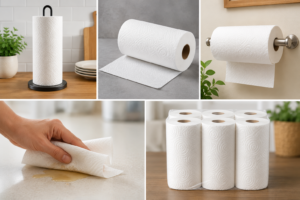
Instead of grabbing whatever’s on sale, it helps to match the towel to what you’re actually doing with it. Everyday kitchen cleanup calls for a standard 2-ply roll. Heavy grease or oil work wants 3-ply or a select-a-size roll with real wet strength behind it. Office or public restroom use is mostly a cost game — multifold or C-fold does the job fine.
Food service kitchens usually do best with center pull, for the one-handed, low-contact grab. Auto shops and workshops want the blue industrial roll built to resist tearing. And if you’re an eco-conscious household without heavy demands, recycled or bamboo covers it without much of a tradeoff.
This isn’t really a one-size-fits-all product, even though most stores shelve it that way. Matching the towel to the task usually cuts down on both waste and spending — you stop burning three sheets of a weak towel to do what one sheet of the right towel would’ve handled.
Frequently Asked Questions
What is paper towel made of?
Wood pulp fibers, recycled paper fibers, or bamboo fibers, pressed into a loose, absorbent sheet and then creped for texture and stretch.
Are paper towels recyclable?
Generally, no. Once a paper towel’s been used to clean up or absorb liquid, it counts as contaminated and goes in the regular trash, not recycling. The unused roll and its cardboard core, though, are typically fine to recycle.
Can paper towels be composted?
In most cases, yes — as long as they weren’t used with chemical cleaners, grease, or anything else non-compostable. Towels used only on water or food scraps are usually fine in a home compost bin.
Why do some paper towels shred more than others?
It usually comes down to ply and fiber quality. Thin 1-ply towels and lower-grade recycled towels tend to break apart faster when wet than a solid 2-ply or 3-ply virgin-fiber roll.
Are bamboo paper towels actually stronger?
In most comparisons, yes — bamboo fiber tends to hold together better when wet than standard wood pulp, which means fewer sheets per cleanup in practice.
What’s the difference between multi-fold and C-fold paper towels?
Multi-fold (Z-fold) sheets zigzag and interlock; C-fold sheets curl into a C shape and interleave in a similar way. Honestly, the difference that matters most is just which dispenser a building already has installed.
Is it bad to use a paper towel on your face?
Not in a pinch. But paper towels are coarser than facial tissue or a cotton pad, so making it a habit can be more abrasive on skin than it’s worth.
