

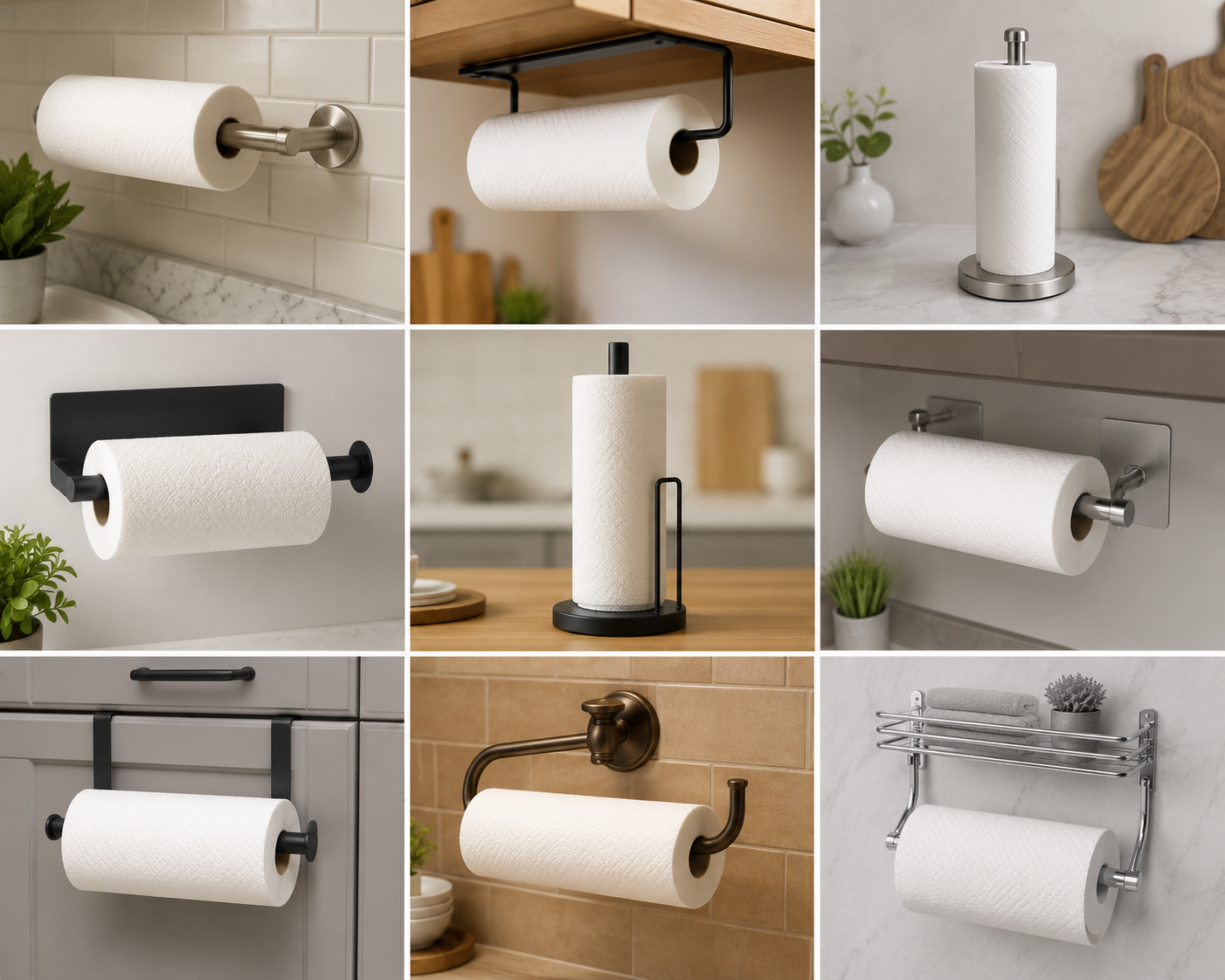
That loose roll sitting on your counter is going to tip over the next time you rip off a sheet with any speed. Mount one to the wall right next to the stove, and give it six months — it’ll be filmed over in grease. Neither is really a “bad product” problem. It’s a wrong-mount-for-the-spot problem, and once you know which mount fits which spot, and which material can actually handle what’s near it, the rest is easy.
Three Mount Types — And Where Each One Actually Earns Its Keep
Under Cabinet Paper Towel Holders
These screw or clip to the underside of an upper cabinet, sitting somewhere around 12 to 18 inches above the counter, roll hanging vertically off a horizontal rod. If your counter space is already crowded, this is honestly the best option out there — you’re using a strip of cabinet bottom that was doing nothing anyway.
There are really just two versions worth knowing:
- Screw-mount brackets — a metal bracket, a couple of screw holes, a paper template to help you line it up. Drill a couple holes and you’re done. These can handle a full commercial 11-inch roll without any sagging.
- Tension-mount (spring-loaded) rods — no drilling. The rod springs open and wedges itself against the inside walls of the cabinet. Fine for a standard 600-sheet roll, but that spring does loosen up over time — expect to give it a re-tighten somewhere around the 6-to-12-month mark.
One thing nobody tells you: if there’s less than about 12 inches between the cabinet bottom and the counter, tearing a sheet one-handed gets awkward. The roll just sits too low and the towel drags across the countertop.
Wall Mounted Paper Towel Holders
This is your pick when there’s no cabinet hovering over the spot where you actually need the towel — next to the sink on a kitchen island, say, or in an RV galley where the layout doesn’t cooperate.
You’ll want a stud, or at minimum a drywall anchor rated for 5 lbs of pull-out force. A full roll only weighs around 1.5 lbs on its own, but every time someone rips a sheet off, that’s a sideways yank on the anchor point — and it adds up over a couple years. If you’ve got an older house with thin drywall, spend the extra dollar on toggle anchors. The plastic expansion kind just doesn’t hold up the same way.
Countertop, Adhesive, and Magnetic Holders
Countertop holders are freestanding — weighted base, vertical post, zero installation. The catch is obvious: it eats counter space permanently, and if the base weighs under about 1.5 lbs (a lot of the cheaper plastic ones do), it tips the second you tear a sheet with any real force.
Adhesive and self-adhesive holders lean on 3M-style VHB tape instead of screws, which is why renters like them so much. But here’s the thing that actually causes most of the failures: humidity. Anything mounted near a sink or stove is sitting in a slightly damp environment, and that tape bond quietly degrades over 3 to 6 months until one day the holder’s just on the floor. Wiping the surface down with isopropyl alcohol before sticking it on roughly doubles how long the bond lasts — new cabinet laminate and freshly painted drywall both carry a thin manufacturing oil film that most people never think to clean off first.
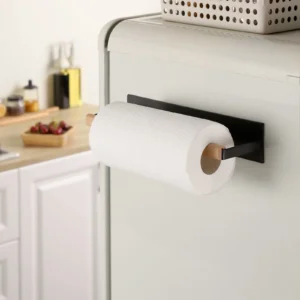
Magnetic holders stick to the fridge or a range hood, but only where there’s actual ferrous metal underneath. A lot of stainless fridge doors are magnetic while the side panels aren’t — worth testing with a fridge magnet before you order one and find out the hard way.
The One-Handed Feature People Skip Over (And Shouldn’t)
A “one handed” paper towel holder isn’t its own category, exactly — it’s an upgrade you’ll find bolted onto certain under-cabinet or countertop models. Instead of a bare spinning rod, the roll presses against a spring-tensioned arm, or sits on a base that’s heavy enough to resist spinning when you pull. Skip that mechanism, and a plain rod will usually give you two or three extra unspooled sheets every time you tear one off, since the roll just keeps spinning past the perforation. If you’re cooking with raw chicken or bread dough — hands that genuinely can’t spare a second hand — this feature stops being a nice-to-have.
Material Comparison: Stainless Steel vs Wood vs Plastic
| Material | Water/Grease Resistance | Weight Capacity | Typical Lifespan | Best For |
|---|---|---|---|---|
| Stainless steel | High — wipes clean, doesn’t soak anything up | Full commercial rolls | 8–10+ years | Right next to the stove or sink |
| Wood | Low — soaks up grease, can warp near water | Moderate | 3–5 years before it starts to show | Farmhouse-style counters, dry spots |
| Matte black (powder-coated) | Moderate — chips if scratched, then rusts at the bare spot | Standard rolls | 4–7 years | Matching matte black hardware |
| Plastic/ABS | Low — yellows near heat, gets brittle | Low to moderate | 1–3 years | Budget buys, RVs where weight matters |
Steel wins near the stove for a simple reason: it’s non-porous, so grease just wipes right off instead of sinking into the surface the way it does with unsealed wood.
Installing an Under Cabinet Holder, Step by Step
- Pick the spot. Measure back 12 to 18 inches from the cabinet’s front edge so the roll doesn’t collide with the cabinet doors when they open, and center it over wherever you actually prep food.
- Mark your holes with the paper template that comes in the box — tape it flat against the cabinet bottom so it doesn’t shift while you mark.
- Pilot-drill first. Use a bit one size smaller than the screws — a 1/16-inch bit works for the #6 screws most kits ship with. Skip this and you risk splitting the thin plywood on the cabinet bottom.
- Drive the screws slowly. Overtightening is the #1 way these fail — it strips the pilot hole right out of the particleboard.
- Load the roll and actually test it. Tear a sheet before you walk away. If the roll spins with zero resistance, give the tension screw a quarter turn.
No-drill tension mounts skip most of that — compress the spring, slide it into place, let go, and the rubber end caps grip the cabinet’s inner walls on their own.
Under Cabinet or Wall Mount? Here’s How to Decide
- Got a cabinet sitting right above your prep area and not much counter to spare? Go under cabinet. It’s the more common setup in apartment kitchens and galley layouts across most of the US.
- No cabinet nearby — island, RV, laundry sink? Wall mount is really your only real option.
- Renting, can’t drill, or want to move it seasonally (near the grill in summer, say)? Countertop or adhesive.
For RV and Camper Kitchens Specifically
RVs move. That’s obvious, but it matters here because vibration from actual highway driving will loosen a standard screw mount over the course of a season in a way a stationary kitchen never has to deal with. Two things to look for that don’t apply to a regular house:
- Spring-tension or locking designs that clamp the roll under a bit of pressure, so it doesn’t bounce loose while you’re driving.
- Marine or automotive-grade VHB tape if you’re going the adhesive route — the standard tape that ships with most home holders just isn’t built for the heat swings inside a parked RV, which can easily climb past 120°F in the summer sun.
Holders With a Built-In Shelf or Storage
Some under-cabinet and wall-mount models tack on a small wire shelf above or below the rod — enough room for a spray bottle, a little basket, maybe a box of foil or plastic wrap. Worth knowing: that shelf changes the weight math. A bracket rated for a roll alone (about 1.5 lbs) might not be rated to also carry another 2 to 3 lbs of shelf stuff. Check the total weight rating before you start loading it up, not just the roll capacity printed on the box.
What Actually Goes Wrong (And How to Fix It)
Roll spins too freely, wastes half the roll on one tear. Not a defect — it’s tension. Spring-loaded rods have a tiny tension screw at one end; turn it clockwise in small quarter turns until a single sheet tears clean. Fixed rods with no adjustment don’t really have a fix beyond switching to a weighted or one-handed model.
Adhesive mount came off after a couple weeks. Nine times out of ten, that’s surface prep, not a bad product. New laminate and drywall both carry a light oil film straight from the factory. Wipe it down with isopropyl alcohol, give it a full 60 seconds to dry, and stick on a fresh pad — reusing the old tape almost never works since VHB loses most of its grip once it’s been peeled.
Under-cabinet holder wobbles. The pilot hole probably stripped in the particleboard. Back the screw out, jam a wood toothpick or two with a dab of glue into the hole, let it dry, then re-drive the screw into the now-filled hole. No need to relocate the whole bracket.
Magnetic holder slides down the fridge over time. The magnets are only rated for so much weight, and a fully loaded roll plus a shelf attachment can push past that gradually. It’s not that the magnet’s wearing out — it’s that the leverage changes as the roll gets used down and the geometry shifts.
FAQ
What is the standard size for an under cabinet paper towel holder? Most fit rolls between 9 and 11 inches long, which covers standard and jumbo sizes. Check the max length on the rod against your usual paper towel brand, since off-brand jumbo rolls sometimes run a bit longer.
Can I install a paper towel holder without drilling? Yes. Tension-mount under cabinet holders and adhesive wall-mount holders both skip drilling. Tension mounts work in pretty much any standard cabinet, while adhesive does best on smooth surfaces like laminate or tile — not textured drywall.
Are magnetic paper towel holders strong enough for a full roll? Most are rated for a full standard roll, around 1.5 lbs, but only on real ferrous metal. Test the exact spot with a small magnet first, since a lot of stainless fridge side panels turn out to be aluminum underneath.
What’s the difference between a paper towel holder and a towel bar? A paper towel holder’s rod is built to spin, usually with some tension so you can tear one-handed. A towel bar just holds a folded cloth towel in place — it’s fixed, not spinning, because nothing needs to tear off it.
How high should a wall mounted paper towel holder be installed? Somewhere between 10 and 15 inches above the counter, positioned so the bottom of the roll clears the counter by at least 2 inches — otherwise the towel end drags through water or food debris.
What’s the best paper towel holder for a small kitchen? Under cabinet, almost every time — it uses space that’s otherwise sitting empty instead of eating into your counter. If you’re renting, lean toward a tension-mount version since it needs no drilling and can move with you when you leave.
