

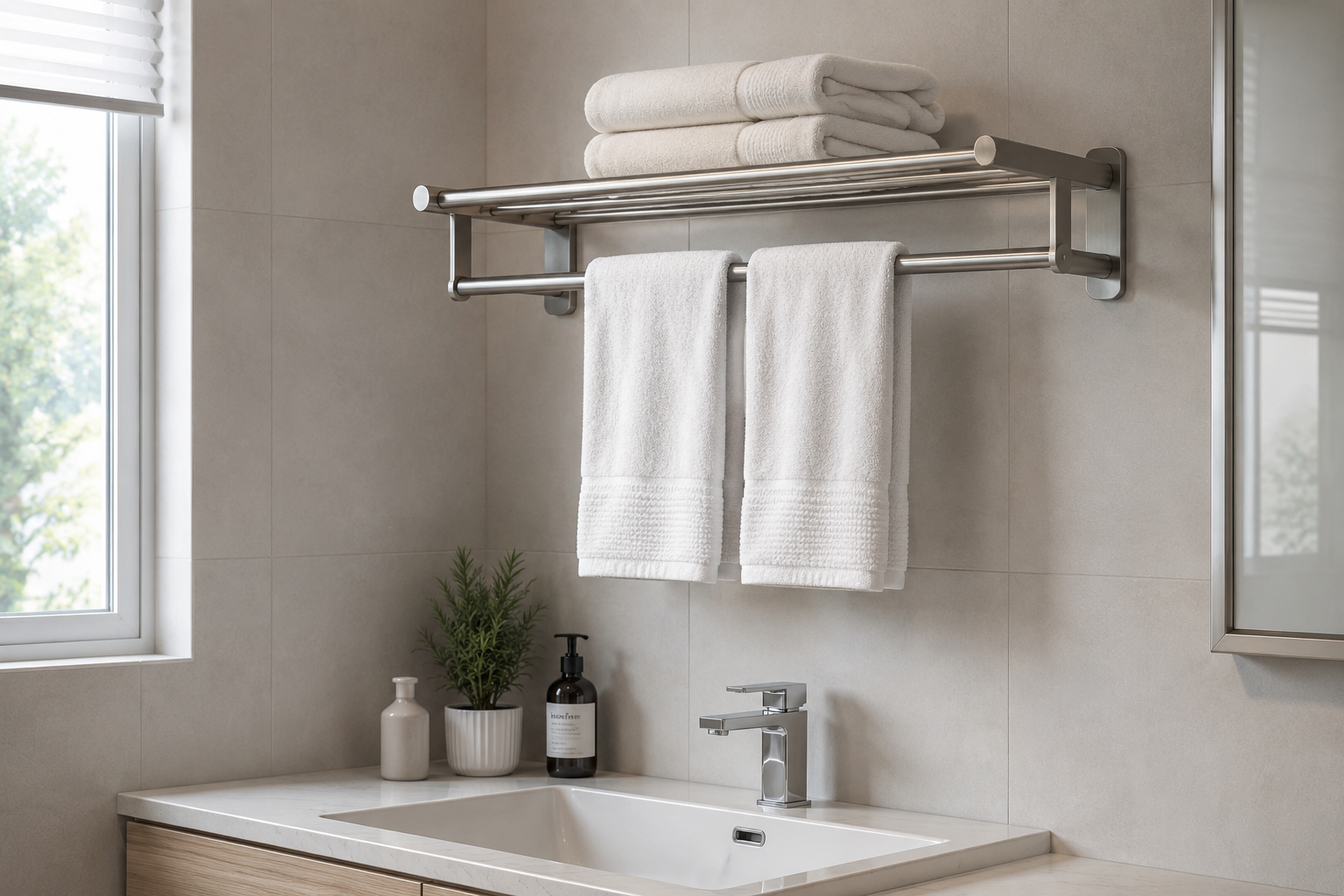
Towel Racks in Pakistan: Types, Materials, and What They Cost
A pile of damp towels on the floor isn’t really a habit problem. Nine times out of ten, it’s a storage problem — there’s simply nowhere proper to hang them. Give a towel somewhere to go, and most of that daily mess sorts itself out on its own. That’s the whole job of a towel rack.
Walk into any hardware market in Pakistan and you’ll see the range: a single steel bar screwed above the basin, a folding stand tucked behind a door, a full wooden unit with shelves for a family bathroom. This guide covers the types you’re likely to run into, clears up the mix-up between racks, rails, bars and holders (sellers use these words interchangeably, which doesn’t help anyone), looks at which materials actually survive local bathroom conditions, talks through what pushes towel rack price in Pakistan up or down, and should help you land on something that fits the space you have — not the one in someone else’s photo.
What Is a Towel Rack?
A towel rack, at its core, is a wall-mounted or freestanding fixture that holds one or more towels so they can hang, get some air, and stay off wet surfaces between washes. It isn’t built for fast, heated drying — that’s a separate category of product entirely.
A few terms worth untangling before you start browsing:
- Towel rack — usually a multi-bar, multi-tier, or shelf-style unit built to hold several towels.
- Towel rail — often just a single straight bar, sometimes heated, fixed horizontally.
- Towel bar — shorter, typically single or double, used for hand towels or one bath towel.
- Towel holder — could be a ring, hook, or short bar near the sink for a single towel.
- Towel rod — a generic name for the bar component itself, wherever it shows up.
You’ll come across listings titled “rail” that are functionally racks, and the reverse. So don’t take the product title too literally — check the photo and the actual dimensions instead. Most towel racks live in bathrooms and washrooms, though smaller hand-towel versions turn up in kitchens near a sink now and then, and freestanding stands work well in bedrooms or dressing areas where a fixed rail isn’t practical.
Main Types of Towel Racks
Wall-Mounted Towel Rack
Screwed and anchored straight into the wall, usually above or beside the sink, or near the shower. Drilling is unavoidable here, so if you’re renting, it’s worth a quick word with the landlord first. A single bar takes one towel; a multi-bar unit takes three or more. What people generally like about this style is that the floor stays completely clear — a real plus in a small bathroom. What they don’t like as much: once it’s up, moving it later means patching the wall and starting over.
Freestanding Towel Rack
No drilling required. It just stands there, which is exactly why renters gravitate toward it, or anyone who likes rearranging furniture now and then. It does eat into floor space more than a wall-mounted rack, and a lightweight one can tip if it’s loaded unevenly. Capacity tends to be generous, though — plenty of freestanding designs pack in multiple bars or a bar-and-shelf combo. Floor space is really the only downside, and in a compact washroom, that’s often the one thing you can’t spare.
Wooden Towel Rack
Sheesham, pine, or something similar gives a warmer, furniture-like feel that metal can’t really match. These suit bedrooms, dressing areas, or larger, breathable bathrooms far better than a small, permanently damp washroom. Left untreated, wood soaks up moisture over time — swelling, warping, sometimes mould. A sealed or varnished finish, kept clear of direct shower spray, is what makes a wooden rack workable in a bathroom in the first place.
Stainless Steel or Metal Towel Rack
For anywhere wet and high-splash, metal is usually the safer call — stainless steel, chrome-plated steel, aluminium, coated iron, take your pick. It copes with humidity far better than untreated wood. Fitting one is straightforward whether it’s on the wall or a freestanding frame, and capacity runs from a compact double bar up to a full multi-tier stand. Durability in a damp room is the whole appeal here. Just watch for cheaper coated or plated metal — it can rust once the coating chips, or if the grade underneath was never really meant for a bathroom in the first place.
Towel Rack with Shelf
A hanging bar plus an open or slatted shelf, giving you somewhere for folded towels, toiletries, or a small basket alongside the hanging space. Good fit for a family bathroom juggling more than one kind of storage. It’s typically wall-mounted and needs slightly more wall space than a bar-only design. Two storage types in one fixture is the obvious win; the shelf part just needs wiping down more often than a plain bar would.
Hand Towel Rack
Small, usually a single bar or a ring, mounted right by the sink for a hand towel — not a full bath towel. Barely any wall space needed, easy to fit. It’s all about convenience exactly where you need it. Just don’t expect it to hold a bath towel; think of it as a companion piece to a full-size rack, not a substitute.
Door-Mounted or Folding Towel Rack
Hangs over the top of a door, or folds flat against a wall — no drilling, no fuss. Good for small bathrooms, shared washrooms, or a temporary setup while you figure out something more permanent. Capacity is modest, a handful of bars at most, and how sturdy it feels depends on the door thickness or the folding hinge quality. Completely renter-friendly is the big win; the trade-off is a lower weight limit, and a door that’s a bit harder to shut once towels are loaded on.
Benefits of Using a Towel Rack
The simplest benefit is also the most obvious once you have one: towels actually get to air out between washes instead of sitting in a damp heap on the floor. Everyone in the house gets their own spot, which quietly puts an end to the morning hunt for a clean towel. In a shared bathroom, a multi-bar rack means used towels don’t have to mix with fresh ones — a small thing, but it adds up. A wall-mounted rack frees up floor space a small washroom genuinely can’t spare, while a shelf-style rack gives you room for folded towels or toiletries without needing a whole cabinet.
Some designs work as a bit of decoration too, especially wood or matte-black finishes that tie in with the rest of the room. That said, it’s worth being upfront: none of this replaces proper washing, or full drying outdoors or in a dedicated warmer. A standard rack is about organisation and a bit of airflow in between — nothing more, nothing less.
Towel Rack Pros and Cons
Advantages
- Organised, dedicated storage instead of towels piled wherever there’s room
- Comes in wall-mounted, freestanding, and door-mounted styles — something for most living situations
- Space-saving options exist at both small-bathroom and small-budget ends
- Multiple bars or tiers mean separate, easy access for more than one person
- Decorative finishes let it match the rest of the bathroom
- Freestanding and door-mounted designs move with you if you relocate
Disadvantages
- Wall-mounted means drilling, which isn’t always an option in a rented place
- Smaller racks fill up fast in a bigger household
- Metal of an unstated or unsuitable grade can rust over time
- Freestanding stands take floor space a compact washroom may not have to give
- Untreated or poorly sealed wood can absorb moisture and warp in humid conditions
- Shelf-style racks need slightly more regular cleaning around corners
- Poor installation — wrong anchors, an uneven mount, a weak wall — can leave a rack loose under perfectly ordinary towel weight
How to Choose the Best Towel Rack
Start with what your bathroom actually has, not what looks good in someone else’s listing photo. Measure the wall space or floor footprint, and factor in door swing and shower door clearance so the rack doesn’t end up in the way. How many people use the bathroom day to day matters too — one person is fine with a single bar, but a household of four or five usually does better with multiple bars or a multi-tier stand, so towels aren’t shared or stacked.
Before locking in a wall-mounted design, check what the wall’s actually made of. Tile, drywall-style partitions, and solid brick or block each need different anchors, and getting this wrong is a very common reason racks come loose down the line. Renting, or just not keen on drilling? A freestanding, door-mounted, or folding rack sidesteps the whole issue.
Match the material to how wet that spot actually gets — a rack right beside the shower deals with far more splash than one near a bedroom mirror, so this is more a functional call than a style one. Check dimensions against your real space, and if a listing quotes a weight capacity, treat it as a rough guide rather than a promise. Cleaning is worth a thought too: open bars wipe down quicker than shelved units with corners to reach into. And budget against lifespan — a slightly better metal, or wood that’s actually sealed properly, often ends up cheaper over a few years than replacing something that rusts or warps within a year.
Best Towel Rack Materials
Stainless steel tends to be one of the more dependable options for a humid bathroom, though the grade genuinely matters. Good quality stainless (usually labelled 304-grade) copes fine with ordinary residential humidity and splashing. A listing that just says “stainless steel,” with no grade mentioned, isn’t really telling you much — worth asking the seller directly. And even good stainless isn’t bulletproof: harsh, bleach-based cleaners can attack it over time and cause pitting, so it’s best kept away from a steel rack.
Aluminium resists rust simply because it has little to no iron in it, though it can still corrode gradually if it’s never cleaned. It’s light, which suits foldable or portable designs, but not quite as rigid under heavy load as steel.
Iron or coated metal is generally the cheaper metal option — but the coating is doing all the work, not the iron itself. Chip that coating, even from a small knock or an overly rough clean, and moisture reaches the metal underneath. Rust spreads outward from there.
Wood, sheesham or pine most commonly here, gives a warmth nothing metal really offers. It doesn’t rust on its own, but that’s not the same as being moisture-proof. A proper sealed or varnished finish, away from direct spray, is what actually keeps it from swelling or warping. Bamboo needs roughly the same care.
Brass doesn’t turn up in budget racks often, but it’s common in higher-end fittings, and it holds up well in bathroom conditions.
Chrome-plated finishes sit over a base metal — often brass or steel — giving a bright, easy-to-wipe surface. As with any plating, how well it lasts comes down to the plating quality and what’s underneath.
Plastic won’t rust, obviously, since there’s no metal involved at all. It’s just less hard-wearing under heavy daily use and can look a bit less finished than metal or wood. Fine for lighter-duty setups — a small hand-towel bar, say.
One thing worth keeping in mind through all of this: no metal on the market is completely and permanently rust-proof, full stop. Grade, coating quality, what you clean it with, how consistently it gets dried — all of it plays a part.
Towel Rack Price in Pakistan
A handful of things move price up or down, and it helps to know them before comparing listings side by side:
- Material — plastic and basic coated iron sit toward the lower end; stainless steel, brass, and solid wood usually cost more.
- Design and size — a single hand-towel bar costs less than a multi-tier stand or shelf combination.
- Number of bars or tiers — more bars generally means a higher price within the same material.
- Shelf inclusion — adding a shelf to a bar-only design pushes up material and manufacturing cost.
- Wall-mounted vs. freestanding — freestanding pieces often use more material overall than a simple wall bracket.
- Imported vs. locally manufactured — imported branded pieces tend to carry a premium.
- Finish quality — a properly plated or sealed finish usually costs more than a basic painted one.
- Brand — recognised bathroom-fittings brands generally price above unbranded listings.
- Installation hardware — some listings include anchors and screws, some don’t, and that changes the real cost of getting it fitted.
- Delivery charges — these vary by seller, city, and order size, and can genuinely shift the final cost on a lower-priced item.
Current prices vary by seller, material, size, and design. It’s best to check verified local listings before purchasing, and compare a few sellers rather than treating one as representative of the whole market. A single steel hand-towel bar, a multi-bar wall rack, and a full wooden freestanding stand are genuinely different product categories — quoting one product’s price as if it applies to all three would be misleading.
Wall-Mounted vs Freestanding Towel Rack
The trade-off is fairly simple at its core: wall-mounted saves floor space but needs drilling and a suitable wall; freestanding skips the drilling but takes up floor area instead.
Space usage — wall-mounted wins in a tight bathroom, no contest. Installation — freestanding is quicker and fully reversible; you could move it out the same day. Portability — freestanding, easily, since a wall-mounted rack is basically fixed once it’s up. Capacity doesn’t really favour one over the other; both can be built with multiple bars or tiers, so it’s more about the specific model than the mounting style. Stability tends to go the other way, though — a properly anchored wall-mounted rack usually holds steadier than a lighter freestanding stand that can tip if it’s loaded unevenly.
Cleaning is generally easier around a wall-mounted bar, since there’s no base or legs collecting dust and water. For rented homes, freestanding, door-mounted, or folding designs avoid drilling altogether, which makes them the sensible pick. In a small bathroom, a slim wall-mounted rack usually beats a freestanding stand simply because it isn’t fighting for floor space.
In a family bathroom managing more towels, a multi-bar wall rack or shelf combination copes better than a single freestanding piece. And in a bedroom or dressing room, where drilling into a feature wall might not be welcome, freestanding or over-door tends to be the more flexible choice.
Best Towel Rack for a Small Bathroom
Small bathrooms usually have more unused vertical space than people realise, even while the floor runs out fast. A tall, narrow wall-mounted rack makes use of that vertical wall without touching the floor at all. A bar-and-shelf combination gives two functions in one footprint, instead of needing a separate shelf and a separate bar taking up two spots. Over-door racks are worth considering if wall space is genuinely tight, since they use a surface that’s already there. Foldable racks suit a bathroom shared by several people at different times — they tuck away when not in use.
A rack with a small basket or a couple of hooks built in can cut down the number of separate fixtures competing for room. What’s worth avoiding is an oversized freestanding stand bought purely because it looked nice online — in a small washroom, that usually ends up blocking movement rather than solving anything. Measure the actual clear space, door swing included, before ordering.
Where Should a Towel Rack Be Installed?
Placement affects both how convenient the rack feels and how long it lasts. Ideally it sits within easy reach of the shower, bathtub, or sink — close enough that grabbing a towel isn’t a stretch, not so close it gets soaked every single time. Ventilation matters here as well; a rack tucked into a poorly ventilated corner dries towels more slowly than one with decent airflow around it.
It’s worth checking the door’s swing path before mounting anything nearby — a rack that blocks the door, or takes a hit from it daily, causes friction and eventually some damage. Spots that catch direct spray from a shower head generally aren’t kind to wood or lower-grade coated metal, even if that’s the most convenient location at first glance. Wall material plays a role too: solid tile-over-block walls generally support wall-mounted fixtures more reliably than thin partition walls, which may need reinforced anchors or a different mounting approach altogether.
In households with children or elderly family members, height and reach are worth thinking through — a rack mounted too high isn’t much use to everyone. There’s no single mounting height that suits every bathroom; it depends on who’s using the space and how the room is laid out. Leave enough clearance around the rack too, so towels hang fully without dragging on the floor or catching on nearby fixtures.
Towel Rack Installation Tips
- Measure the rack — check both its own dimensions and the wall or floor space you’re installing it into.
- Mark the position — use a level to mark bracket points evenly before any drilling starts.
- Check the wall material — tile, drywall-style partition, and solid block or brick each call for different anchors.
- Locate studs or use suitable anchors — on partition walls, find a stud or use anchors rated for the wall type and expected load.
- Confirm alignment — double-check the marks are level before drilling; re-drilling into tile is hard to hide afterwards.
- Drill carefully — use the right bit for tile or masonry so you don’t crack the surface.
- Secure the brackets — tighten fully and make sure they sit flush against the wall.
- Test stability — apply gentle pressure and hang a towel on it before trusting it with daily use.
Installation needs vary from product to product depending on wall type and hardware supplied, so treat this as a general sequence rather than fixed instructions for every rack. For tiled walls, anything load-bearing, or work near electrical wiring, it’s genuinely safer to bring in a professional than to attempt it yourself.
Care and Maintenance
A regular wipe-down with a soft cloth goes a long way. Dry the rack afterwards rather than leaving it wet — standing moisture is behind most corrosion and staining issues over time. It’s best to skip abrasive cleaners, scouring pads, or steel wool on metal racks, since they can leave tiny particles behind that lead to rusting, and harsh bleach-based cleaners can pit even good-quality stainless steel. A mild, non-abrasive cleaner and a soft cloth are the safer combination for metal fixtures.
Check screws and wall anchors now and then too — they loosen with regular use, particularly on freestanding stands with hinges or folding joints. Wooden surfaces may need occasional resealing once the original finish starts wearing thin, especially in spots that see regular splash. Shelves and corners on shelf-style racks collect dust and soap residue faster than a plain open bar, so they need a bit more attention. And where a manufacturer gives specific cleaning instructions, follow those over general advice — finishes and coatings do vary between products.
Common Buying Mistakes
- Buying without measuring the actual space, then finding the rack doesn’t fit or blocks the door.
- Ignoring wall type, and mounting a heavy rack with anchors that were never suited to tile or a thin partition.
- Choosing an unsuitable material — untreated wood or unspecified “metal” — for a high-splash spot.
- Overlooking towel size, ending up with a rack too short for a full-size bath towel.
- Picking design over function — a striking freestanding stand that doesn’t actually fit the floor space.
- Assuming every rack has similar capacity; bar and tier counts vary quite a bit even between similar-looking designs.
- Ignoring installation hardware, then finding the listing doesn’t include anchors suited to your wall.
- Buying an oversized stand for a small room, which tends to block movement more than it solves storage.
- Confusing towel racks with heated towel rails or paper-towel holders — different products, different installation and electrical needs.
Final Buying Recommendation
Let your bathroom guide the decision, not the other way round. In a small or rented washroom, a slim wall-mounted bar or a door-mounted design avoids wasted floor space and any drilling commitments. In a busier family bathroom, a multi-bar or shelf-combination rack in stainless steel generally copes with daily wear better than wood would in a high-splash zone.
Want a decorative touch and the room stays reasonably dry? A sealed wooden stand works nicely in a bedroom or dressing area. Whatever you land on, measure first, confirm the wall type before drilling, and compare a few sellers — material grade, size, and included hardware vary enough across Pakistan’s market that price on its own won’t tell you much about value.
FAQs
What is the price of a towel rack in Pakistan?
It depends on material, size, bar or tier count, and whether the piece is imported or locally made. A basic single-bar or coated-iron rack sits toward the lower end; multi-tier stainless steel or solid wood pieces cost more. Best to check a few verified local listings rather than go by one figure.
Which towel rack is best for a bathroom?
Depends on the bathroom’s size, wall type, and how many people use it. Stainless steel wall-mounted racks generally handle humidity and daily splash well; a freestanding or shelf-combination design suits a bathroom that needs extra storage or a no-drilling setup.
Is a wall-mounted or freestanding towel rack better?
Neither wins outright — wall-mounted saves floor space but needs drilling and a suitable wall, freestanding skips the drilling but takes up floor area instead. Renters, or anyone unsure about drilling, are usually better off with freestanding, door-mounted, or folding designs.
Is a wooden towel rack suitable for a bathroom?
It can work well, as long as it has a sealed or varnished finish and stays out of direct shower spray. Untreated or poorly sealed wood absorbs moisture and can swell or warp in a consistently wet bathroom, so it tends to suit drier zones or well-ventilated rooms better.
Which material is best for a bathroom towel rack?
Stainless steel, particularly a stated 304 grade, generally handles bathroom humidity and cleaning well. Brass and aluminium hold up nicely too, thanks to their low iron content. Coated iron and lower-grade metals are cheaper but more prone to corrosion once the coating chips.
What type of towel rack is suitable for a small bathroom?
A slim, vertical wall-mounted rack or a bar-and-shelf combination makes good use of limited wall space without eating into the floor. Over-door and foldable racks are worth a look too when wall space itself is tight.
Where should a towel rack be installed?
Within easy reach of the sink, shower, or bathtub, but outside the direct spray zone, with enough ventilation for towels to air out. Worth accounting for door swing, wall material, and the height of whoever’s using the bathroom.
Can a towel rack be installed without drilling?
Yes — freestanding stands, over-door racks, and folding designs all skip drilling entirely, which makes them a practical choice for rented homes or anywhere permanent fixtures aren’t allowed.
What is the difference between a towel rack and a towel rail?
A towel rack usually means a multi-bar or multi-tier unit for several towels, while a towel rail is often a single straight bar, sometimes heated. Sellers use the terms loosely, so check the photos and dimensions rather than trusting the listing title.
How do I prevent a metal towel rack from rusting?
Dry it after cleaning rather than leaving it wet, keep bleach and other chloride-based cleaners away, and skip steel wool or abrasive pads, which can leave particles that rust. Picking a stated stainless steel grade over a generic “metal” listing also lowers the risk.
